
AWS BedRock: Is your Data secure?
There has been some concerns from enterprise leaders and professionals about the data security and governance as there has been lot of security issues with usage of LLMs and generative AI. This is where Amazon Bedrock’s security first architecture comes into picture. Amazon Bedrock is not just a platform for accessing cutting-edge Foundation Models (FMs); it’s an architectural commitment from AWS to maintain the highest levels of data privacy, regulatory compliance, and security isolation.H ere is a detailed breakdown of the three core pillars that make Bedrock the most trusted environment for your mission-critical GenAI applications.
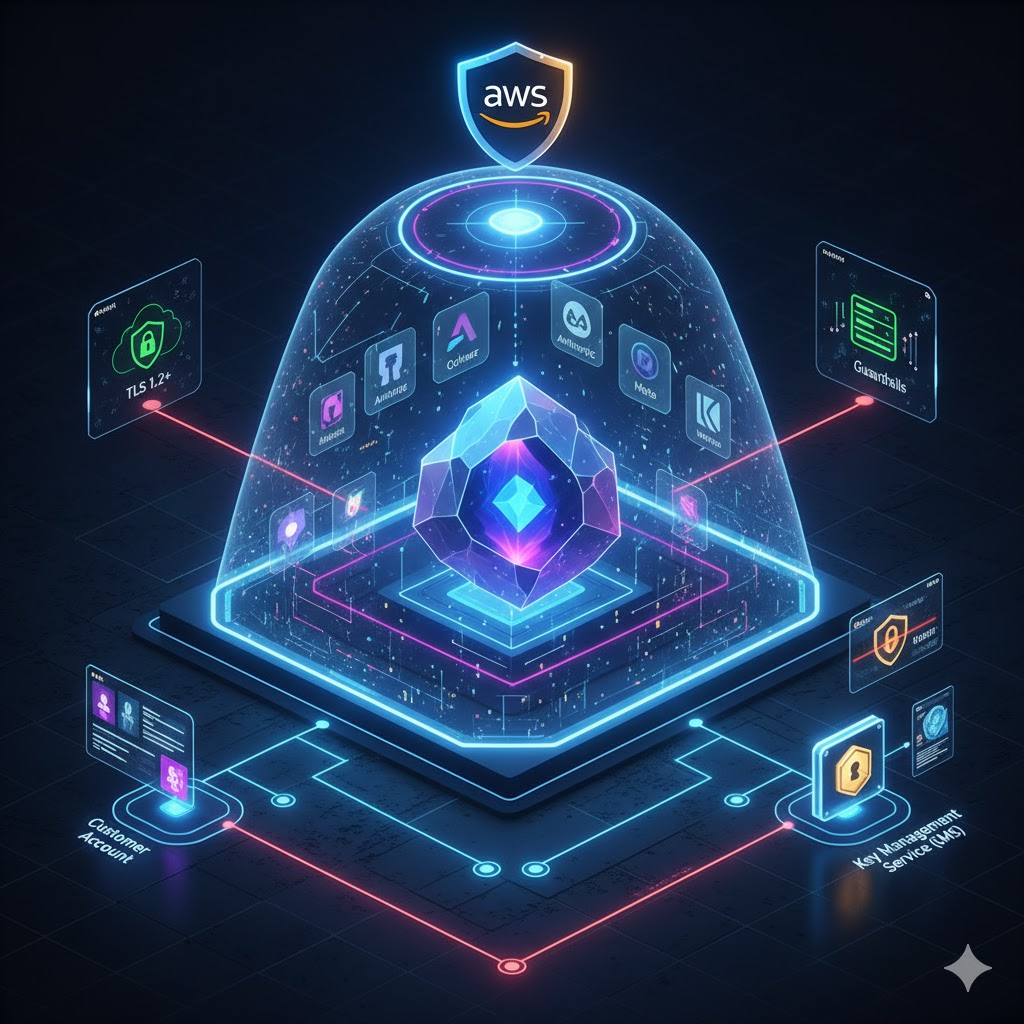
Amazon BedRock Security
- Full Control of the Model Weights (No External Vendor Exposure)
- Unwavering Privacy: Prompts and Data Are Never Used for Training
- End-to-End Encryption with Customer-Managed Keys (CMKs)
Full Control of the Model Weights (No External Vendor Exposure)
A common security challenge when integrating third-party LLMs is relinquishing control to an external vendor’s API environment. Bedrock eliminates this external risk by fundamentally changing the model access architecture.
Model Weights Stay on AWS
The foundational model weights—the “brains” of models from providers like Anthropic, Cohere, Meta, and others—are securely hosted and managed entirely within dedicated AWS service accounts.
Your Calls Are Always Internal
When your application or service makes a request to a Foundation Model on Bedrock (using the bedrock:InvokeModel API call), you are not making an external third-party API call. Instead, you are connecting directly to an AWS-managed service endpoint. This crucial design choice means that all communication remains within the secure AWS backbone, reducing latency, simplifying network compliance, and minimizing the attack surface associated with cross-cloud communication.
Unwavering Privacy: Prompts and Data Are Never Used for Training
The most significant security and trust feature of Amazon Bedrock is its explicit, non-negotiable commitment to data privacy regarding model training. Your data is your intellectual property, and Bedrock treats it that way.
The Zero-Training Guarantee
By default, the input prompts, user data, and model outputs (responses) that flow through the Bedrock service are never used to train or improve the underlying Foundation Models. This principle ensures that your proprietary business logic, sensitive customer interactions, and unique conversational data cannot inadvertently be learned, exposed, or used by the model provider or by other AWS customers.
Complete Vendor Isolation
This privacy boundary extends to the model vendors themselves. Your conversational data and prompts are not passed to the model vendors. AWS operates as a trusted, secure intermediary, ensuring model providers have absolutely no visibility into the customer-specific content or the context of your application’s interactions. This critical layer of abstraction is essential for enterprises operating under strict data governance and confidentiality mandates.
End-to-End Encryption with Customer-Managed Keys (CMKs)
Robust encryption is foundational to the Bedrock security architecture, applied consistently across both data in transit and at rest.
Strong In-Transit Encryption
All communication between your applications and the Amazon Bedrock service is enforced using industry-standard, secure protocols, specifically TLS 1.2 minimum. This ensures that data is encrypted while traversing the network, protecting it from interception.
At-Rest Encryption and CMK Control
Data is encrypted at rest using AWS Key Management Service (KMS). However, the security deepens significantly for customized models:
- Custom Key Ownership: When you fine-tune or pre-train an FM on Bedrock, the resulting custom model artifact is deployed and encrypted using a key that you control. You have the option to use your own Customer Managed Keys (CMKs).
- Decryption Control: By using your CMK, you retain the ultimate control over access to your customized model. Only your authorized roles and services—granted permission via your key policy—can decrypt and invoke that fine-tuned model. This is the gold standard for data sovereignty, ensuring your intellectual property remains locked behind your cryptographic controls.
In conclusion, Amazon Bedrock provides an enterprise-grade shield for Generative AI development. By securing the model weights, isolating customer data from vendor training, and offering deep control over encryption keys, Bedrock delivers the confidence and compliance necessary for large organizations to integrate powerful AI safely.