
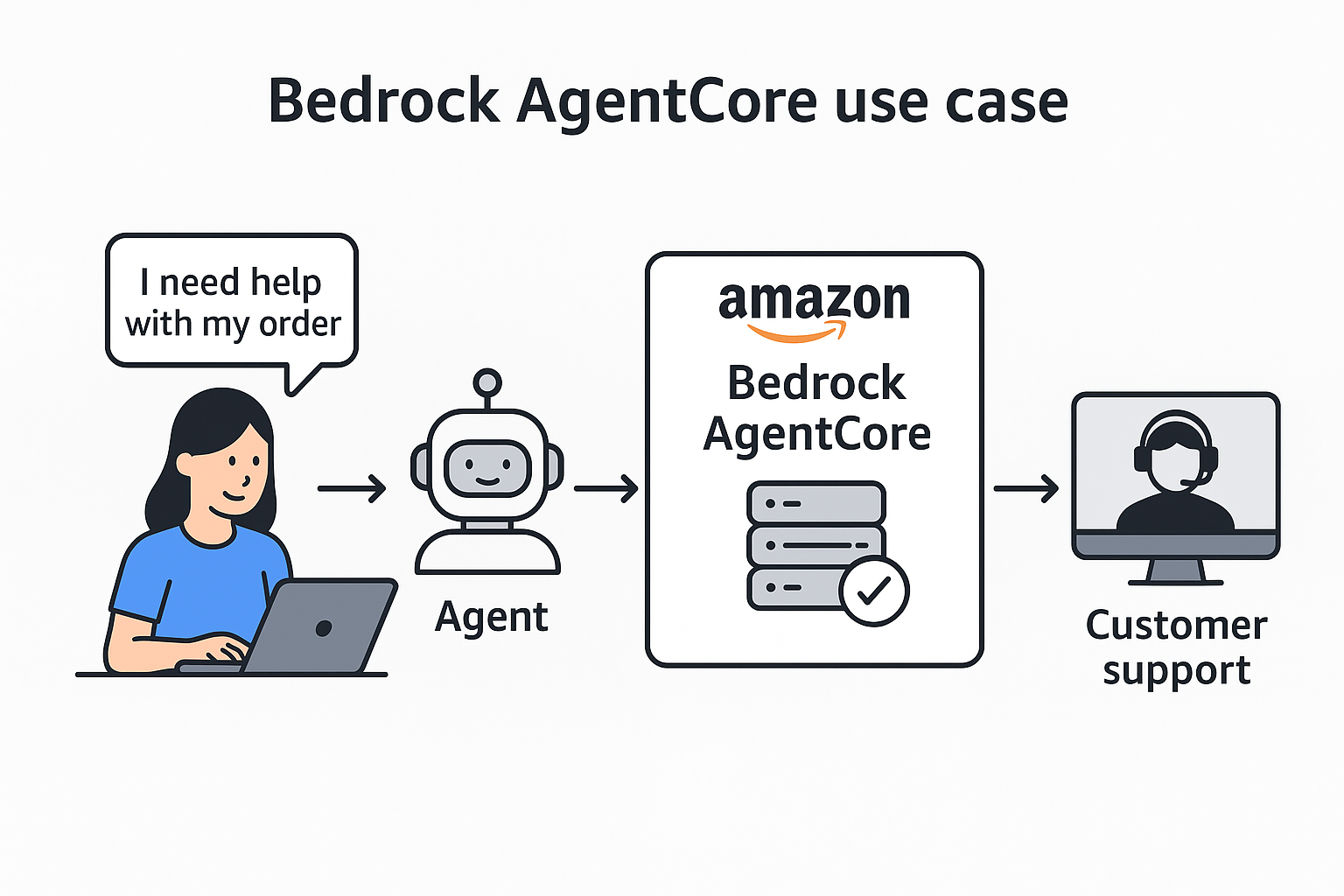
Amazon Bedrock AgentCore: Production-Ready AI Agents on AWS
Amazon Bedrock AgentCore (often abbreviated AgentCore) is a platform by Amazon Web Services (AWS) designed to help organisations build, deploy, and operate AI agents at scale in production with enterprise-grade security, reliability, and flexibility. Let’s break down what AgentCore is, its key services, and why it’s a game-changer for moving AI agents from prototype to production.
“Amazon Bedrock Agent” – Explanation
Before we dive into AgentCore, let’s clarify the other feature of Bedrock called as BedRock Agents . The standard Amazon Bedrock Agent is a fully managed service that lets you build a simple AI assistant. You give it three things:
- A Brain: A Bedrock foundation model (like Claude 4 or GPT models on BedRock or your own customized model).
- Tools (Action Groups): The power to execute code via AWS Lambda functions or call APIs.
- Memory (Knowledge Bases): Your own company data (from Amazon S3, etc.) so it can give specific, accurate answers.
This is perfect for building a customer support bot, a report summarizer, or a simple internal helper.
Amazon Bedrock AgentCore – Explanation?
Amazon Bedrock AgentCore is a composable set of services designed to help organizations build, deploy, and operate highly capable AI agents at scale in a production environment. Crucially, AgentCore is designed to be model and framework agnostic. You aren’t locked into a specific AWS model or framework. You can bring your own open-source frameworks like LangChain, CrewAI, or LlamaIndex and use models from anywhere, all while leveraging AWS’s production-ready infrastructure.
BedRock Agents vs BedRock AgentCore
These are the differences between BedRock Agents and BedRock AgentCore
| Feature | Amazon Bedrock Agents (The Original) | Amazon Bedrock AgentCore (The Platform) |
| Primary Goal | Simplest possible, fully managed agent building. | Enterprise-grade infrastructure for deploying and operating agents at massive scale. |
| Use Case Focus | Quick prototyping, basic internal tooling, simple configuration-based agents. | Mission-critical, high-traffic, complex, multi-tenant agent systems. |
| Framework Agnostic? | No. Tightly integrated and prescriptive with Amazon Bedrock models and tools. | Yes. Designed to work with any model (Bedrock or external) and any open-source framework (LangChain, CrewAI, LangGraph, Strands Agents, etc.). |
| Architecture | Monolithic (Fully managed service). You configure the agent and AWS handles the rest. | Modular (Composable services). You pick and choose the infrastructure components you need. |
| Level of Control | Low. AWS manages the agent’s orchestration, runtime, and memory behind the scenes. | High. You write the custom agent logic and deploy it onto AgentCore’s infrastructure. |
| Other Features | N/A | Runtime Isolation, Dedicated Identity/Auth, Browser Tool, Code Interpreter, Modular Memory, Gateway, Enhanced Observability. |
Key Modules of Bedrock AgentCore
AgentCore is modular, not monolithic. You can pick and choose the services you need to plug into your existing architecture. Here are the main components:
AgentCore Runtime
This is the serverless, scalable execution environment for your agents. It’s built to handle long-running sessions, ensure session isolation (so one user’s agent doesn’t “talk” to another’s), and support multi-modal workloads.
AgentCore Memory
An agent is useless if it can’t remember context. This service provides robust short-term and long-term memory management, allowing agents to recall past interactions and build context over extended sessions.
AgentCore Gateway
How does your agent securely call your internal CRM, your third-party shipping API, or a Lambda function? The Gateway standardizes this. It converts your existing APIs and functions into agent-compatible tools and supports modern protocols for model interaction.
AgentCore Identity
This is critical for security. The Identity module manages authentication and authorization for your agents. An agent might need to act on behalf of a specific user (with their permissions) or as a service identity. It integrates with providers like AWS Cognito, Okta, and others.
AgentCore Browser Tool
What about legacy systems that don’t have APIs? This is a managed, sandboxed browser environment. It allows your agents to securely interact with web pages, navigate sites, and scrape data, just like a human would, but at enterprise scale.
AgentCore Code Interpreter
This provides a secure sandbox for agents to execute code, typically Python scripts. This unlocks powerful capabilities like data analysis, on-the-fly calculations, data processing, or creating visualizations.
AgentCore Observability
If you can’t monitor it, you can’t run it in production. This module provides the monitoring, tracing, and telemetry needed to understand agent behavior. You can track token usage, API call latency, errors, session durations, and tool usage to debug and optimize performance.
Why Bedrock AgentCore Matters for Your Enterprise
AgentCore isn’t just another AI service. It’s a platform focused squarely on solving the “Day 2” operational problems.
- Model & Framework Agnostic: This is a huge win. You’re not locked in. Use CrewAI with a model from OpenAI, or LangChain with a model from Anthropic, all hosted and managed by AgentCore’s runtime.
- True Production Readiness: Features like VPC support, IAM integration (via
AgentCore Identity), secure sandboxing (for theBrowser ToolandCode Interpreter), and deep observability are non-negotiable for mission-critical applications. AgentCore builds them in. - Modular Architecture: You don’t have to adopt the entire stack. Already have your own vector database for memory? Fine. Just use the
AgentCore RuntimeandGatewayto execute your agent and connect it to your tools. - Solves Real-World Problems: Agents often need to do more than just chat. With the
Browser Tool, they can automate legacy web UIs. With theCode Interpreter, they can perform complex analytics. This moves them from “toys” to “tools.”
Common Use Cases
- Autonomous Internal Agents: Build an agent that interacts with GitHub, Slack, and your CRM to manage a support ticket from creation to resolution, with full audibility.
- Legacy System Automation: Use the
Browser Toolto automate data entry or reporting from an old internal web portal that lacks a modern API. - Secure Data Analysis: Deploy an agent that can receive a natural language query, write and execute a Python script via the
Code Interpreterto analyze data, and return a summary. - Scalable Customer Service: Move beyond simple FAQs to an agent that can check order status, process a return, and escalate to a human, all while maintaining session memory and identity.
The “Gotchas”: What to Be Aware Of
As with any new platform, there are considerations to keep in mind:
- Preview Status: As of its mid-2025 announcement, AgentCore is in preview in select regions. Features and availability will expand over time.
- Evolving Features: This space is moving fast. Advanced features like true agent-to-agent communication may still be evolving.
- AWS Ecosystem: While it’s model-agnostic, it is an AWS platform. You’ll be operating within the AWS billing model, compliance frameworks, and regional availability.
- Cost Management: A powerful, scalable, serverless system is a dream, but it requires diligent monitoring. Observability will be key to managing your token and compute costs.
Building a demo is easy, but running a secure, governed, and scalable agentive system is an infrastructure nightmare. y providing a modular, composable, and agnostic platform, AWS BedRock is handling the “hard stuff”—the runtime, security, memory, and observability—so your developers can focus on what matters: building powerful agent logic that delivers real business value.